Thursday, June 15, 2017

Communities That Garden; Silver Springs Botanical Garden


     Back in May we took a trip to the Silver Springs Botanical Garden in North West Calgary. The unveiling of 1000 red and white tulips, planted for Canada's 150th, was taking place although the weather had been so hot the tulips were a little past their prime. I had never been here as it is a fair drive from my part of the city but it is well worth it. The gardens are 100% volunteer started in 2007 after the planting of a Birth Place Forest (there's a few around the city planted in honour of babies born that year) and carved out of a grassy strip/sound barrier from two major freeways. It is quite amazing as there are many grass strip/ sound barrier walls in almost any major city but none look quite like this! There are 12 distinct areas in the 1,347 sq metres like the shade garden, fruit garden, low H20, Old Post garden, Oval garden and Shakespeare garden. I have learned that this is the only Shakespeare garden west of Ontario, named for plants mentioned by the Bard.


The Wall garden runs quite a distance and has a South West exposure which is very beneficial to many plants in a setting like this with the sound barrier providing shelter and residual heat for the plants.


Here a cherry tree comes into bloom as perennials begin to grow.


Here some perennials and vines in the Old Post garden so named for a post left over from an old ranch.


The Rose Bowl, not looking like much this early in the season however the planting of Concorde Barberry was flourishing, I am not familiar with this variety but it apparently does very well here and has a beautiful compact habit with very dark foliage.


Some shots from around the Half Moon garden and Shakespeare garden.


Fruit garden at the peak of spring bloom, mainly apples but also some pears and various berries.


All along the edge of the grass strip which is also an off leash area are various garden beds, well maintained and cared for.


The Labyrinth is another highlight, made from nine thousand bricks and interplanted with decorative thyme, this seemed very popular with kids and parents tracing the entire path!


Here the bricks and thyme form the labyrinth pattern.


Just north of the Labyrinth is a curly que planting of columnar aspens, in the centre a brick circle. It's a nice effect and best use of columnar aspens I have seen yet!


One of the volunteers was out promoting a new feature for the garden, QR codes, if you have this app on your phone you can simply scan the code and a list of plants will pop up like here in the Lo H2O garden (plants that need little water, if you don't get it). Then you can identify and read about all of the plants in this garden, instead of looking for a tag. I love the idea and find this is a very useful resource.

     This garden is well worth the field trip, I should go again at prime bloom season. There is a website for more information and directions although I found it quite easily and have never been there before. I don't know whats in the water up there but I wish more communities cared and took the time for projects like this! This garden is an example for communities all over the country and is a valuable resource for gardeners in this area!


Thursday, June 1, 2017

Welcome Spring! May in Photos


     Happy Spring! It's nice to be working with plants again instead of suffering the long winter we just went through. It has been a few decades since we've had such a cold and snowy winter, everyone I talk to is so glad it's over!

While we had record snowfall on Christmas Eve, which was bloody magical, the windchills in the minus 30's left me cold. The below normal temps continued through most of April but came to a sudden halt in May which was well above normal, more like summer weather in the high 20's C. The sudden shift in weather made everything bloom almost at once from early bulbs to lilacs in the span of a few weeks.


     I planted these Quail Daffodils not knowing they are not really suited to our zone, I later read best in zones 5 to 8! Remember that we are zone 3. So, although late, partly due to our cool April, they bloomed nicely in early May and a few weeks later in other areas of the yard more in the open. They are small yet bright and lovely and also bloom in 3's on the same stem. I'm still a bigger fan of regular old Dutch Master Daffodils though.


     I experimented with some tulip varieties I ordered from Veseys, because I am a total sucker for plant ctalogues! This one is Antoinette Bouquet, a multi-headed bloomer that also changes colour as it ages. Even though I am not big on yellow flowers this variety is so bright in the garden that I can make an exception.


     This tulip is called Black Hero, a peony type variety. It would have been a bigger clump except the resident baby jack rabbit bit off a few buds just to see what they tasted like and then spit them out on the ground. 


The parrot tulip, Texas Flame, has excelled in our hot spring weather blooming early for our region. The bright colours are wonderfully eye catching.


Pasque Flower is derived from the native Prairie Crocus so exceeds in our climate, this plant blooms for weeks in the spring often having seedheads and flowers at the same time.


I spotted this Mayday tree in my neighbourhood, perhaps one of the largest around. Usually one of the first trees to bloom in our area, also nicely scented. The flowers only last a week or so before turning into small black berries later on.


     A hillside of Saskatoon Berries blooms in a mass of white, these too only last a week or so before turning into the berry adored for pies.


New this year, vegetable boxes! I took a large Manitoba Maple out of this location and decided to grow a few vegetables. This area gets about a half day of sun but gets very hot in the afternoon. From the foreground is pole beans and squashes; onions, wasabi and red cabbages; peas, kale and radishes; and finally beans and swiss chard. Against the fence is a shorter growing and super early yellow corn.
This was a helluva project that was way more expensive than I thought, from the boxes to the soil to the tree removal so lets hope this pays off!!! I will give updates of course. If the hot weather holds for the whole summer we will be in good shape.


Wednesday, February 8, 2017

Caring for Hyacinth (or any spring bulbs) Indoors and Out


     I have been buying Hyacinth flowers for Valentines Day for the last 30 years. Way back in those days when I was a young art student I had read about the Greek Myth of Hyacinthus. There are many versions but it ends in a Hyacinth sprouting from the blood of said character. Thinking this was one of the most romantic and most gay thing I had heard of in antiquity I adopted it as a way to "reclaim gay history" which is how we talked in art school in those days!


     Here is a Baroque looking painting of the story, look it up if you like, it involves a love triangle, a discus, one jealous God and one more figure of Mythology sprouting into some kind of plant, there are many stories like this about flowers and trees from the Ancient Greeks.

     I usually buy a potted Hyacinth or a few, sometimes they come in 3's, right around this time of year from my local grocery store, look around, get a deal! You can usually tell the colour from the bud, if not the tag. My preference is purple or the Delft Blue variety, you can see the streaks of colour on most buds as they emerge from the leaves except for white which will appear light green.
Place in a bright or sunny window, it says not to but I've had no problems in full sun, and water regularly. The blooms will fill your house with the scent of spring for a week or so. 
After the flowers have faded leave the green stem and leaves to wither naturally, keep watering on a regular basis, once or twice a week, also fertilize once or twice a month for the next few months. By May place the whole plant outside to finish off its growth cycle, continue fertilizing and watering until around July, by this time they should be fading away completely. Leave in a dry place indoors or out until September. They must be kept dry during this rest period over the summer.


     Hopefully you will have marked a spot where you can plant Hyacinth bulbs back in April or May when you know where all the bulbs you have are planted? Don't make my mistake and drive a shovel into perfectly innocent bulbs in the fall because you are sure there is nothing there! Anyway, simply remove the bulbs from the dry soil and the dried leaves and plant 6 to 8 inches deep around late September. Next Spring you will have new Hyacinth to delight you for many years! You can also do this for any bulb you may buy during this time of year, Tulip, Daffodil, Crocus etc.


Tuesday, November 8, 2016

October in Photos

   
     October was a struggle between two weather patterns that brought us some pretty strange moments. It was not the usual warm days and frosty nights but rather a continuation of Pacific moisture that brought us fog and snow! In fact Thanksgiving was unprecedented for the cold weather, just a few degrees above freezing, the local meteorologists had to look several decades into the past to find one nearly as cold in the records. So I missed my very favourite time of year with leaf changing colour mostly because a lot of leaves will not change after prolonged cold, however, by the end of the month we were seeing temperatures quite above normal so I could get in a few hundred spring bulbs! This is likely the last of monthly round ups as our growing season has ended, from now until March it is pretty much winter. I do hope to write a few articles over the winter though so stay tuned! Until next spring enjoy October in photos!


I spotted these wild asparagus in my local park. apparently they do very well in our climate and can naturalize easily. I don't recall them turning such a brilliant yellow but with strange weather we often get strange results with plants. I thought these asparagus were quite something with their fine foliage!


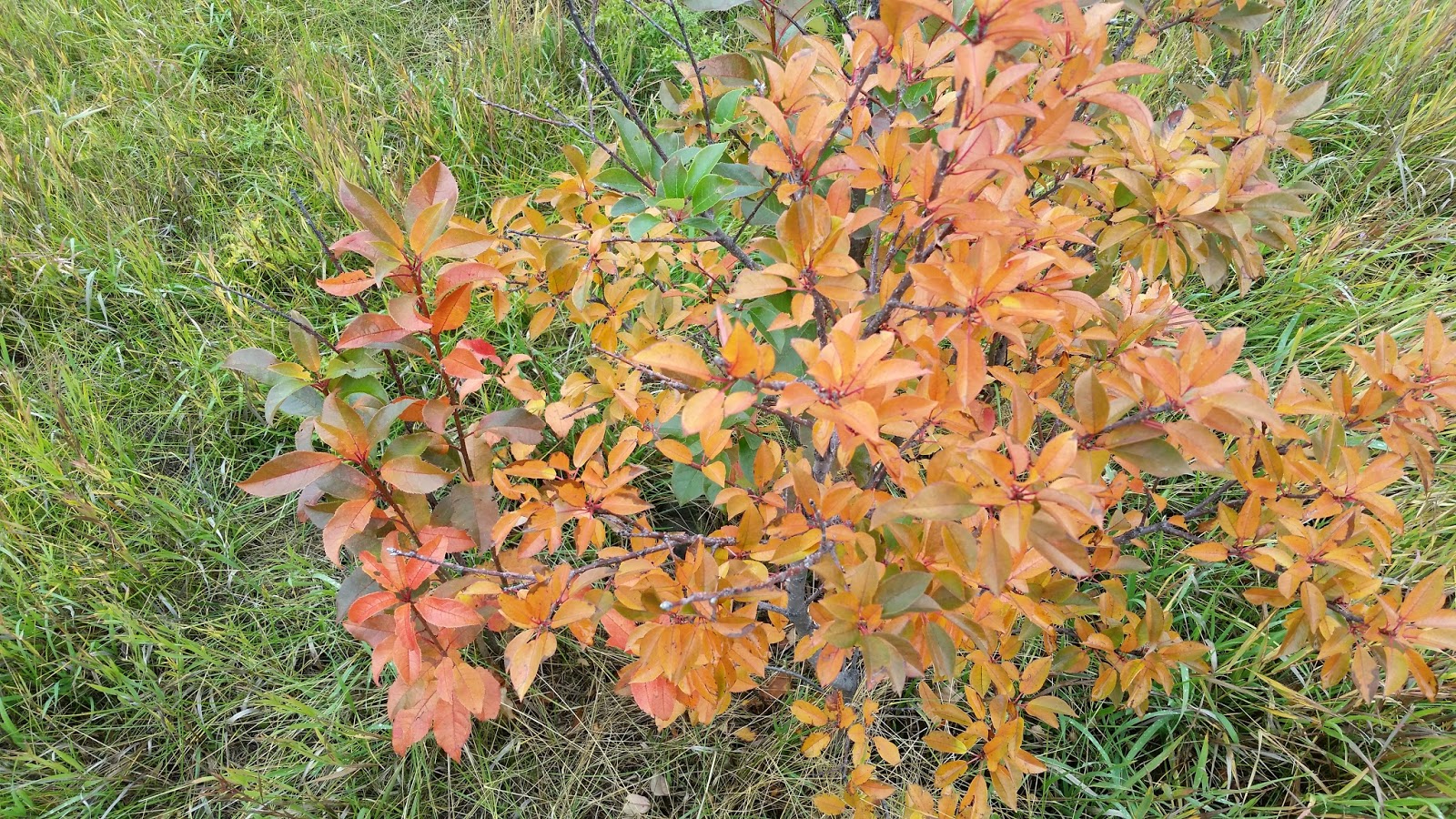
This is either a Choke Cherry or Mayday or some such genus, either way I thought the orange was really outstanding.


This Hawthorn turned a deep shade of red like many kinds of trees in the apple family.


Even through the cold and snow these Mountain Ash maintained a good show through October, they are some of the last trees to lose their leaves and among the few that turn red.


The snow seemed to fall for days on end, however, the ground is still warm so most of it melts quite quickly and although it looks cold it's often not cold enough to damage plants too much, it's more of a weighing branches down issue.


Fog is a little unusual around these parts so when it goes on for a few days it starts to feel like we're back on the West Coast! It's interesting for a while but after many days of cloud and fog and snow it begins to weigh on the soul.


I'm glad I got these Ornamental Kale this year as it has turned out to actually be a very mild late fall and I still have them outside right now in the second week of November! I did move them inside the house during our snowy period though, they may have survived the temperatures but the snow may have been damaging in other ways. And who doesn't want half a dozen plants and planters in their living room for the holiday!?!?


I've had these Italian Asters for years and I've seen them shrug off -10C and heavy wet snow, blooming happily away well into November!


Wednesday, October 5, 2016

September in Photos


     As Marianne Faithfull sang, "The summer dying, September lives in flame." I find this month bittersweet, everything has grown to it's full potential and yet lives on borrowed time as the days grow shorter and colder, one never knows when we will get a frosty night! September was still shaped by our continuous strange weather pattern, a few very nice days followed by a few very rainy days. I often look forward to September to enjoy some warm and dry weather to enjoy the last few weeks in the garden, but it was not as nice as normal. Above some of the changing wild foliage around here, Manitoba maples, Saskatoon berries and wild roses put on a show.


Robert Kemp Canna 


Ricinus with its prickly seed pod.


Amur maple is one of the first to change in my yard.


A few of this years tomato crop.


A mix of poppies bursts into bloom.


Trembling Aspen turns a bright yellow before the long winter season.


Trembling Aspen and Spruce are two of the most common tree species in South Western Alberta.


Ornamental Kale is a must have for the fall season, these tough plants can last through October and part of November depending how cold it gets.


Peacock Kale has a finely cut leaf.


Manitoba Maple "Sensation" is a nice cultivar of the familiar wild species that turns many shades of red and orange and yellow.


The same Sensation Manitoba Maple from a different angle a few days later.


A Staghorn Sumac catches the last rays of September sun.


My Linda Campbell Rose bloomed for the third time this year, which has never happened before! It also has some canes as tall as the fence which is almost 6' or 2m.


Some of the landscape in my area, even these scrubby areas of wild trees and shrubs look nice in the fall.


Once in a while a corn cob from the decorative Japanese stripped corn grows to full maturity. They can be kept for fall decoration.