A living fossil is not your Great Aunt! It is a species that appears in the fossil record that is also a living species today, there are many living fossils like Ferns and Mosses, Lichens, Dragonflies, Cockroaches, Sharks, Alligators and the Coelacanth to name a few. Many of these plants and animals evolved many millions of years ago and remain virtually unchanged to this day. This year I am growing two living fossils in my Calgary garden, Ginko and Kentucky Coffee Tree. I read an article in the Calgary Herald about growing Ginkos in Calgary a while back and have heard of people growing them in Calgary too, both species seem cold hardy enough so I thought why not try?
The Ginko has a long and colourful history that takes us from the beginning of tree evolution thru ancient China to the present day! Here a fossilized Ginko leaf appears unchanged from it's modern counterpart.

Ginkos are a gymnosperm which means "naked seed", there are many gymnosperms you are familiar with including conifers and cycads as well as gnetophytes which are a very unusual plant you must google if you've never seen before! Gymnosperms deveolp their seeds on the surface of leaves or scales (cones) from wind born pollen which also means these trees are dioceous or male and female individuals. Gymnosperms evolved in the late Carboniferous and Devonian periods over 300 million years ago in an era of giant horsetail and clubmoss trees as well as the sail-backed Dimetrodon that is the ancestor of all mammals and predates the Dinosaurs. The Ginkos became their own genus in the Jurassic period about 150 to 200 million years ago and would look recognizable to us, the picture at top header with Stegosaurus is this epoch. The Ginkos reached their peak diversity with multiple species in the Cretaceous period, the last epoch of the Mesozoic with Dinosaurs like Tyrannosaurus Rex and Triceratops. Ginkos disappear from the fossil record in the Pliocene, 7 million years ago in North America and over 2 million years ago in Europe. It is thought that Dinosaurs were a dispersal mechanism for Ginkos, ie, they would eat the seeds and excrete them so the decline of multiple species of Ginkos coincides with the extinction of Dinosaurs.

Fast forward to Ancient China where the Ginko Biloba, the only remaining species of Ginko in the world, was cultivated over 1,000 years ago. It is believed Ginko originates in the Tianmushan region of China, now a UNESCO biosphere reserve where semi wild stands of Ginko grow today. This region is the birthplace of Daoism, in earlier times it was also the centre of shamanic tree worship so the Ginko easily became a symbol of longevity and vitality. In more recent times the Ginko has retained status in Buddhism and Confucianism and is used in traditional Chinese medicine and as food in China and Japan.

Ginko was planted in Chinese temples and introduced to Japan by monks over 500 years ago. Some of the Ginkos in China are over 150 feet tall and 2,500 years old! The picture above shows an ancient Ginko in an Asian Temple shedding its brilliant yellow leaves in the fall. The Ginko is the official tree of Tokyo. In Hiroshima there are six Ginkos that survived the atomic bomb 1 to 2 km from ground zero! Now that is one tough tree!
Ginkos were first encountered by Europeans by Engelbert Kaempfer in 1691. The German botanist brought Ginko seeds back to Holland where one of the first trees was planted at the Botanical Gardens in Utrecht where it can still be seen today. Ginko has been cultivated in Europe for over 300 years and in North America for around 200 years.
Growing Ginko Biloba in Calgary

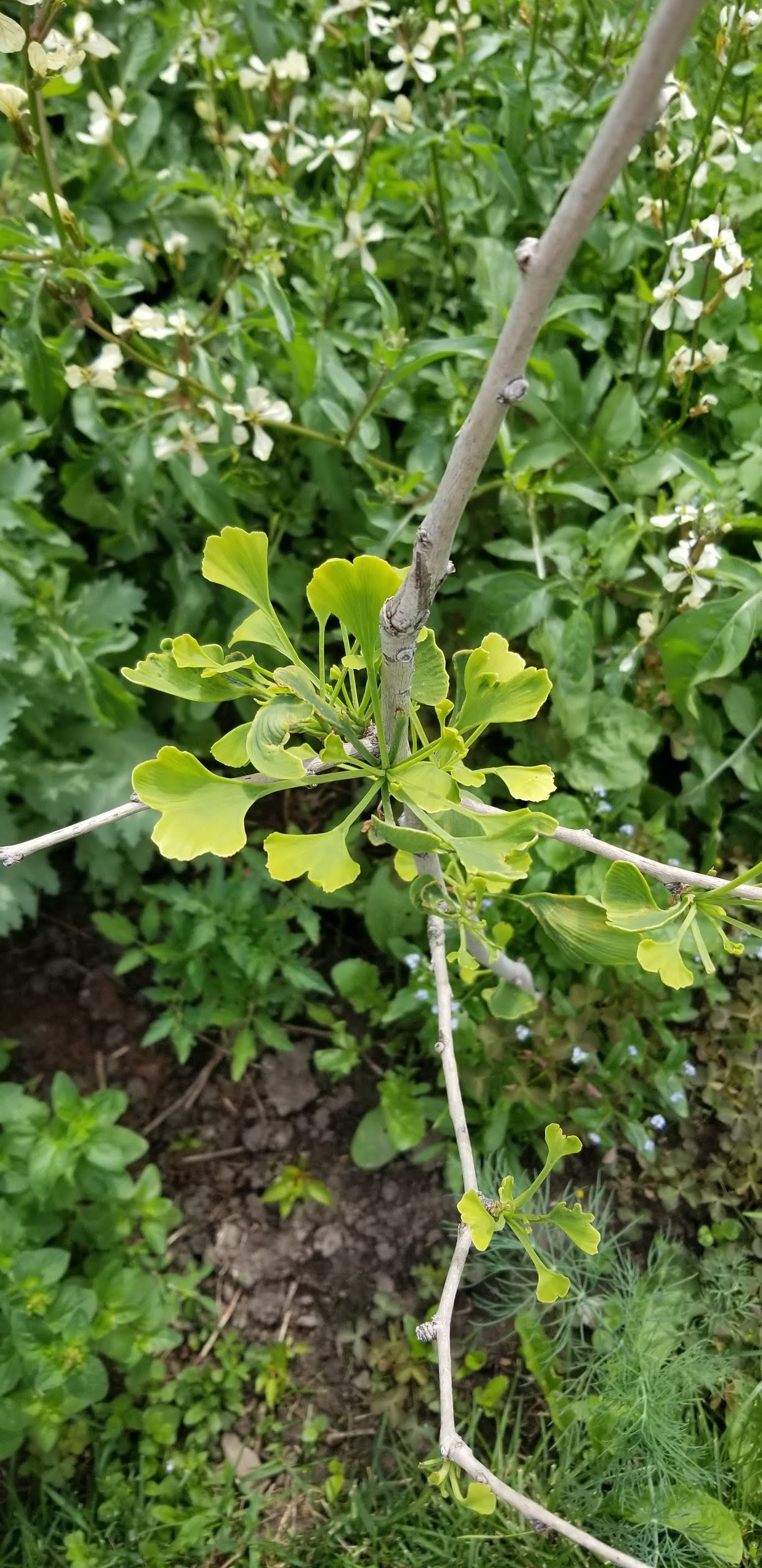
I have heard of a few Ginkos growing in Calgary over the years and Lois Hole had listed it as one of her " Favourite Trees and Shrubs" in the book of the same name. These trees are rated hardy to USDA Zone 3 which is -30 to -40 and in Canada they are rated Zone 4 which is -30 to -34.5 so pretty cold tolerant, I've seen them growing as boulevard trees in Eastern Canada so with a little care they could grow here as well. Ginko grows from 60 to 115ft tall and some in China are 150 ft tall! Don't worry though I have read that they grow very slowly in our region and very few trees, especially non native trees, reach their maxium height. In cultivation Ginko likes a sunny location and apparently resents too much shade, they like a well watered and well drained environment. There are a few varieties of Ginko these days, mostly male selections to avoid messy seeds, which come in a variety of shapes and heights and bred for other pleasant qualities. It pays to shop around too, I saw potted Ginkos for sale at a local greenhouse for just over $100 but I got two Ginkos mail order from Vesey's Seed Catalogue for around $10 each, they arrived bare root in a box about 36" tall. I planted one in a sheltered and hopefully not too shady location and the other in a pot as I've heard they do very well as bonsai and I absolutely have no more room! They began leafing out in May and are doing quite well, the one in the pot is doing better than the planted one as it has more sun in the day, it just seems happier and has more growth.

This Ginko receives a half day of sun but will be well sheltered in the winter.
This Ginko is growing in a pot so can be in the most sun possible, it has grown at least 4" or 10cm by mid July. I have overwintered many trees in pots for a few years so we're hoping for the best!
Ginko leaves emerge in the spring like intricately folded pieces of paper.
Here is a bonsai Ginko in the Botanical Gardens of Montreal, if you have a few decades and a lot of patience you can achieve this too!
The second living fossil is the Kentucky Coffee Tree,
Gymnocladus dioicus, not as old as Ginko but still evolved from a much earlier time in North America. In the article "Trees That Miss The Mammoths" Whit Bronaugh explains how many species of trees were adapted to the mega fauna like mastodons and giant ground sloths of the earlier Pliocene epochs to eat and disperse their seeds. He cites many examples of trees that have large fruit or large seed pods that evolved to be food for these large and now extinct animals, plants like the Osage-orange and Kentucky Coffee Tree are prime examples. The article also mentions trees with large thorns such as Hawthorns which evolved to protect themselves from these large herbivorous mammals, deer for example can chew between the thorns a ground sloth or mastodon could not. Since it has only been a few million years since many of the large mammals of North America went extinct, and in the case of mammoths only a few thousand years!, trees have not changed or evolved in that short a time, that is to say evolutionarily it is a very short time.

In a previous time the seeds of this tree would have had their coatings scratched by the teeth and stomach acid of a mastodon, there are relatives of this tree in Africa where elephants eat the seed pods so we can understand the relationship. These trees survived extinction by growing in low lying swamps and dropping their seeds where it could rot the seed coating thus aiding germination This tree is native to the Mid West and Northern areas of the Southern States of North America roughly from SE South Dakota to Minnesota and Wisconsin to Southern Ontario south to Northern Louisiana, it was first encountered by Europeans in Kentucky hence the name. The seeds can be roasted as a coffee substitute but unroasted they are toxic to humans. The USDA lists these trees as hardy to Zone 3 -30 to -40 and I had also read hardy to -37 which is still hardy enough for our region. These trees have tri-pinnate leaves a lot like Japanese Aralia that are very large, the latin name means bare twig as when the leaves fall in the autumn the tree appears stick-like very much like the Sumac.

These trees can grow 60 feet tall and 50 feet wide and are a unique and popular shade tree in cultivation, They are also reportedly very resilient to road salt, ice, heat, cold, drought, alkaline soil, and insects! Sounds pretty good as a street tree!!! Coffee trees bloom in small raceme like flowers and are diocious, male and female individual.
Kentucky Coffee Trees are very late leafing and early dropping in the fall so I really wonder if we have a long enough season for the flowers let alone pods to develop, this was my experience with Amur Mackii here.
I also ordered this tree through the mail from Vesey's for just over $10, I really think it should be a trial tree for our area but since the experimental horticulture program is long gone from Alberta I thought I would do it for you, you're welcome!
Here's an image I snagged of a mature tree, the beauty is truly amazing! The only one I remember seeing in real life was at the UBC Botanical Gardens in Vancouver, I remember thinking, I've heard about these but never seen one before!
I'll be giving updates in the Fall and again next Spring of course so stay tuned!!!